History · Milot
Sans-Souci Palace: Haiti’s royal ruins at Milot
Picture a king’s court in the Caribbean mountains: ministers at work, a royal mint striking coins, gardens with fountains and canals, a grand staircase built to impress foreign visitors. That court was real, it stood in Milot, and its ruins are still there. Sans-Souci Palace is where the story of King Henri Christophe comes into focus, and it sits at the very start of the road to the Citadelle. Here is what it was, what you will see, and how to plan the visit from Hidden Palace.
A palace built for a king
Haiti won its independence on January 1, 1804. Within a few years, the country had split in two. In the north, Henri Christophe, one of the generals of the revolution, took power and in 1811 proclaimed himself king, as Henry I. A monarchy needed a seat, and Christophe built one at the foot of the mountains near the village of Milot.
Built between 1810 and 1813, Sans-Souci was far more than a residence. UNESCO describes an architectural ensemble grouped like an amphitheater over about eight hectares. Around the royal residence stood the buildings of government: the State Council, the Palace of Ministries, the Royal Mint and a library. There was a residence for the crown prince, an esplanade for official ceremonies, stables, barracks, an arsenal, workshops, a hospital and goldsmiths. Gardens, basins and fountains tied it together. UNESCO points to the Baroque staircase, the classical terraces, the stepped gardens reminiscent of Potsdam and Vienna, and the canals and basins freely inspired by Versailles. Foreign visitors of the time wrote about its splendor.
The name means “carefree” in French. It echoes Frederick the Great’s palace in Potsdam, and it is also the name of Jean-Baptiste Sans Souci, a revolutionary commander who refused to follow Christophe and was killed on his orders in 1803, on land close to where the palace was later built. That shadow is part of the story, and good guides tell it.
Christophe’s reign was built on hard labor and it ended in revolt. Ill after a stroke and facing rebellion, he took his own life at the palace on October 8, 1820. His followers carried his body up the mountain and laid it to rest inside the Citadelle. The palace was looted and then abandoned, and in 1842 a severe earthquake, which also devastated Cap-Haïtien, destroyed much of what remained. It was never rebuilt.
In 1982 UNESCO inscribed Sans-Souci on the World Heritage List together with the Citadelle and the Ramiers site, as the National History Park: universal symbols of liberty, and the first monuments built by people who had freed themselves from slavery.
What you’ll see today
Even as a ruin, Sans-Souci holds together. UNESCO calls it an impressive and coherent ruin, and that is exactly how it feels on the ground. You walk up toward the staircase, pass beneath tall walls and arched openings that stand open to the sky, and look out over terraces where the royal gardens once stepped down the slope. The mountains close in behind, and on the heights above you, out of sight from much of the palace, sits the Citadelle.
Next to the palace stands the domed Church of Our Lady of the Immaculate Conception, on the site of Christophe’s royal chapel. It was rebuilt after the earthquake and has served the town as its parish church. Around the site, Milot goes about its day. Many families here make their living from visitors, as guides, horse handlers, drivers and vendors, so the money you spend locally matters.
Check before you go: In early September 2026, Haiti’s Minister of Culture inspected Sans-Souci after reports that sections of wall had collapsed and some structures had been weakened by recent storms. Some areas may be restricted while the damage is assessed. Ask our front desk for the latest before you set out.
Sans-Souci and the Citadelle in one day
Traditionally, the two have been one outing. The road up to the Citadelle begins right behind the palace, so visitors would see Sans-Souci and then continue up the mountain to the fortress, or climb first and walk the palace ruins on the way down. It is the most complete way to understand Christophe’s kingdom: the royal court below, the stronghold on the heights above.
Right now, the Citadelle itself is closed to visitors. Authorities suspended visits after the tragedy of April 11, 2026, and as of September 2026 a new visitor protocol was still being prepared. Read our Citadelle Laferrière day trip page for the latest we know, and we will tell you where things stand when you book.
Getting to Milot from Hidden Palace
Milot lies south of Cap-Haïtien, and Hidden Palace makes the trip easy.
- Private car service. The simplest option. Book it when you reserve or the evening before, and your driver takes you to Milot and waits or returns for you.
- Car rental on site. Prefer to drive? Rent a car at the property and come back to free parking.
- Local shuttle. Ask at the front desk whether the local shuttle fits your plans for the day.
- Breakfast first. The free buffet breakfast is ready before you go, so you can make an early start without skipping a meal.
Coming for a family reunion or a group trip? The whole house gives you all four bedrooms and seven beds under one roof, and a private car can take everyone together.
Tips for your visit
- Go early. Morning light is kinder for photos of the facade and the staircase, and the air is cooler.
- Wear good shoes. You will walk on uneven stone, grass and steps.
- We do not publish figures we have not checked.
- Hire a guide if you can. The ruins are beautiful on their own, but the stories of the court, the name and the king’s end make them unforgettable. Ask us for a recommendation.
- Respect the ruins. Walls are fragile, especially after storm damage. Stay on paths and out of cordoned areas.
- Give yourself time in Milot. Buy a cold coconut, talk to the vendors, visit the church. It is part of the experience.
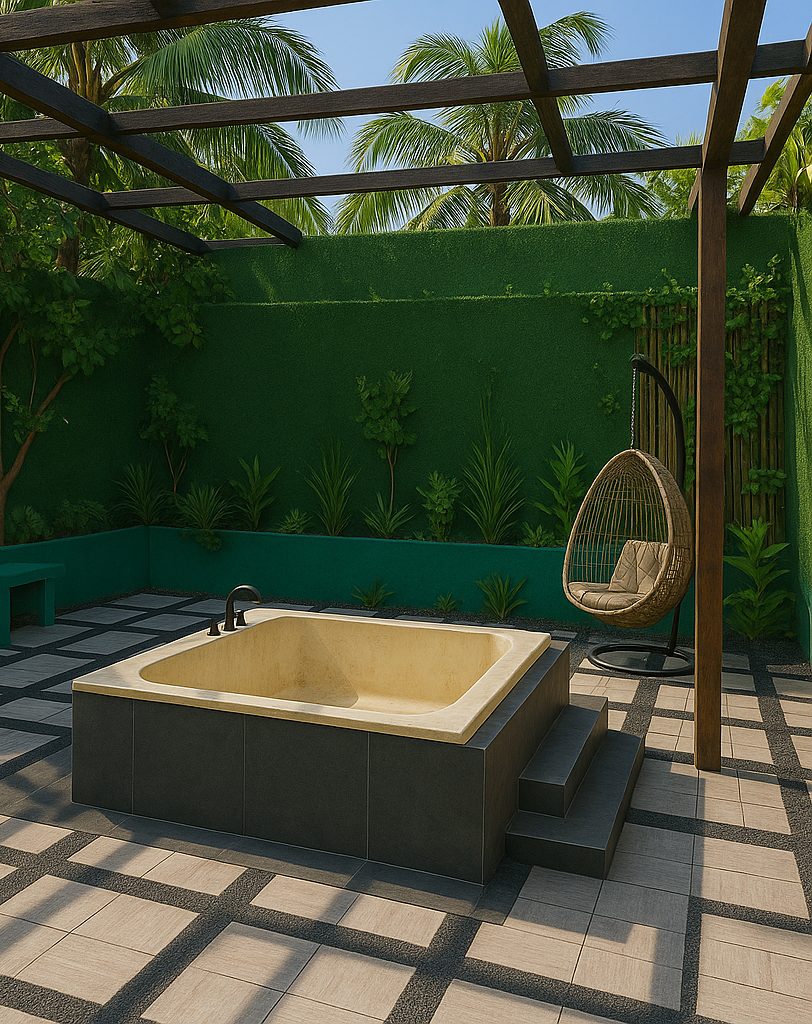
When you get back, the day slows down. Dinner is served at our restaurant with table service and a buffet, the bar is open, the outdoor jacuzzi is waiting, and room service runs around the clock. The front desk is open 24 hours, so there is never a rush to be back.
Sans-Souci questions, answered
What does “Sans-Souci” mean?
It is French for “carefree.” The name is shared with Frederick the Great’s palace in Potsdam and with Jean-Baptiste Sans Souci, a revolutionary commander killed on Christophe’s orders in 1803.
Why is Sans-Souci Palace in ruins?
After Christophe’s death in 1820 the palace was looted and abandoned, and the earthquake of 1842 destroyed much of it. It was never rebuilt. Recent storms in 2026 caused further damage.
Is Sans-Souci part of the UNESCO World Heritage Site?
Yes. It was inscribed in 1982 together with the Citadelle and the Ramiers site, as the National History Park.
Can we visit Sans-Souci while the Citadelle is closed?
Call us before your visit and we will tell you what is open.
Stay close to Christophe’s kingdom
Sans-Souci rewards the traveler who arrives rested, with time to look properly. Make Hidden Palace your base: free airport shuttle when you land, free buffet breakfast every morning, private car service to Milot, and a quiet night after.
- Book your stay (the whole house on Airbnb, single rooms by phone or WhatsApp), or call (561) 484-4210, 24 hours a day.
- See rooms and the whole house and how to find us on RN #1.
- Planning several days? Our 3-day Cap-Haïtien itinerary puts Milot, the city and the coast in order.
- Also nearby: Labadee and the north coast and more things to do near Cap-Haïtien.
Book your stay
Your dates. Our welcome.
- Free airport shuttle. No haggling at arrivals.
- Free buffet breakfast, every morning you’re here.
- A real person, 24 hours a day. Call (561) 484-4210 and speak to the property directly.
- Room for everyone. Couples, families and groups, up to the whole house.
Booking a single room?
Single rooms are booked by phone. Call and we’ll check your dates.