
Ask anyone who grew up in Haiti what they miss most, and the answer usually comes back as a smell: garlic and sour orange on frying pork, rice turning black in a pot of mushroom broth, fish simmering with lime and hot peppers. Food is how Haitians celebrate, mourn, welcome and remember. In Cap-Haïtien, a port city with the sea on one side and farmland on the other, it is also one of the best reasons to visit.
If you are coming to the north for the first time, or coming home after years away, this is your list. It covers the plates to order, the street snacks to look for, the drinks to try, and a few habits that keep your stomach happy. Consider it an invitation to eat well.
The classics you have to try
Griot with pikliz and bannann peze
If Haiti has a national plate, this is a strong candidate. Griot is pork shoulder marinated in citrus, garlic and herbs, simmered until tender and then fried until the edges crisp. It arrives with pikliz, a fiery slaw of cabbage, carrots and hot peppers pickled in vinegar, and bannann peze, green plantains fried, flattened and fried again. The mix of rich, sharp and crunchy is why people order it again and again.
Diri ak djon djon
Rice cooked in the dark broth of djon djon, small black mushrooms from the north of Haiti, turns a deep grey-black and picks up an earthy, savory flavor. It is a dish for Sundays and special occasions, and it is worth seeking out here, close to where the mushrooms come from. Visit Haiti recommends pairing it with poisson gros sel.
Poisson gros sel
Whole fish cooked slowly with coarse salt, lime, onions, peppers and herbs, in a fragrant broth. On a coast like this one, it is the dish that tells you how fresh the fish is. Order it at a place near the water and take your time.
For fish by the water, our guide to the best beaches near Cap-Haïtien covers the coves west of the city.
Lambi
Conch, known as lambi, is a north coast favorite, served grilled or in a spicy Creole sauce. Visit Haiti lists it among the dishes served at Belly Beach, west of the city, alongside fish and lobster.
Tassot and legim
Tassot is goat or beef, marinated, boiled and then fried until the outside is crisp. Legim is a thick vegetable stew of eggplant, cabbage, chayote and spinach, often cooked with a little meat and served over rice or mayi moulen, a soft cornmeal that is the everyday comfort food of many Haitian homes.
Soup joumou: the taste of freedom
Every January 1, Haitian families share soup joumou, a rich pumpkin soup with beef, vegetables and pasta. Under colonial rule, the story goes, enslaved people cooked it but were not allowed to eat it. After independence in 1804, it became the dish of freedom. In 2021, UNESCO inscribed joumou soup on its Representative List of the Intangible Cultural Heritage of Humanity. Some families also make it on Sundays, so if you see it on a menu at another time of year, order it.
Our guide to the best time to visit Cap-Haïtien lists January 1 and the other holidays worth planning around.
Street food and snacks
Some of the best flavors in Cap-Haïtien come from small stands and home kitchens. Visit Haiti’s city guide points visitors to fritay, the fried street snacks sold across the country, and to crispy pâté, Haitian hand pies. A few names to know:
- Fritay: fried snacks such as plantains, sweet potato and marinated pork, usually with pikliz on the side.
- Akra: fritters made from grated malanga or cassava, crunchy outside and soft inside.
- Pâté: flaky pastries filled with spiced meat, herring or chicken, perfect for breakfast on the go.
- Kasav with manba: cassava flatbread with spicy Haitian peanut butter. Visit Haiti describes kasav workshops near Cap-Haïtien where you can watch it made by hand.
- Tablèt: a sweet brittle made with peanuts, cashews or coconut, sold by vendors and small shops.
Drinks to go with it
- Fresh juices: passion fruit (grenadia), soursop (kowosòl), mango or papaya, depending on the season. Ask how they are prepared.
- Prestige: Haiti’s best-known beer, and the one you will see in every cooler.
- Rum: Haiti has a long rum tradition, from aged bottles to rum sours at the bar.
- Kleren: a strong artisanal sugarcane spirit, sometimes infused with ginger, cinnamon or roots. Visit Haiti calls it a real taste of Haiti. It is powerful, so go slowly.
- Coffee: Haitian coffee is strong and often sweet. Mornings on the boulevard start with a cup.
Where to eat in and around the city
Cap-Haïtien’s seafront boulevard is lined with restaurants and bars, and it is liveliest on Sundays, according to Visit Haiti’s Cap-Haïtien city guide. The same guide suggests places such as Cap Deli for generous comfort food and Boukanye for Haitian classics like poisson gros sel. Restaurants open and close, so check that a place is operating before you set out. For a beach lunch, the coast west of the city has small restaurants serving fish, lambi and lobster.
Heading out to eat is also a transport question. Taxis do not use meters, so agree on the fare first, or let our private car service take you and bring you back. Our guide to getting around Cap-Haïtien explains the options, and our guide to money, SIM cards and Wi-Fi in Haiti covers the cash you will need, since smaller places rarely take cards.
Eat well, stay well
A few habits let you enjoy all of this without losing a day of your trip. Canada’s travel health advice sums it up as “boil it, cook it, peel it, or leave it”.
- Drink bottled or treated water, and ask whether ice is made from treated water.
- Choose food that is cooked fresh and served hot. Busy stands with a fast turnover are usually a good sign.
- Peel fruit yourself, and go easy on raw salads at first.
- Pikliz is hot. Try a little before you add a spoonful.
- Carry hand sanitizer and wash your hands before you eat.
Eating at Hidden Palace
You do not have to go far for a good meal. Every morning at Hidden Palace starts with a free buffet breakfast. Our restaurant serves Haitian cooking with table service and a buffet dinner, the bar is there for a cold drink in the evening, and 24-hour room service means a hot plate can reach your room whatever time you land. See our dining page for more.
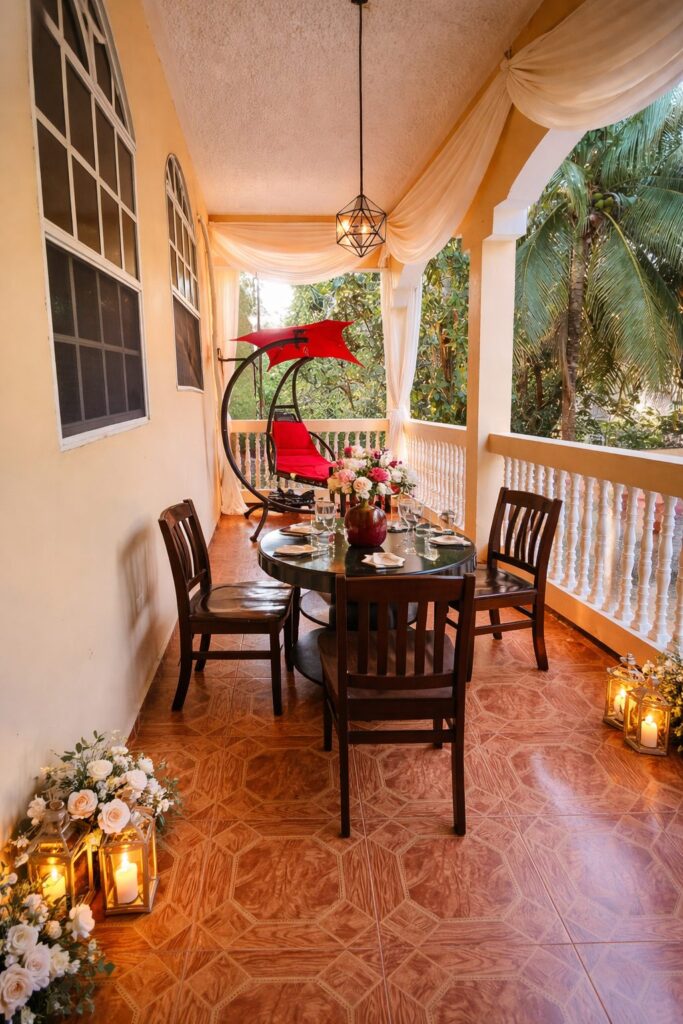
For families and groups, the whole house has a covered balcony with a dining table, the courtyard and the living room, so a long dinner can turn into an evening together.
Come hungry
Food is the easiest way into Haitian life, and the north is a generous place to start. Plan a day in town with our 3-day itinerary, browse more things to do near Cap-Haïtien, and come back to Vaudreuil for dinner, a dip in the outdoor jacuzzi and a good night’s sleep. Landing late and hungry? Our guide to booking a last-minute room in Cap-Haïtien explains how to sort out a bed and a hot meal in the same call.
For a day in town, our walking guide to the historic center includes Marché Cluny and the seafront boulevard, and our guide to things to do in Cap-Haïtien has more ideas. Coming home after years away? Our guide for the Haitian diaspora is written for you.
Book the whole house on Airbnb for your family or group, with all 4 bedrooms and 7 beds, or call or WhatsApp us about a single room.